Loneliness Hub

Context
Problem
Goal
Cigna's Loneliness Hub project was a high profile project that tied in with the company's expansive research on loneliness. The project lasted for a little over two months and was presented at a company-wide town hall.
The stakeholders needed a location on Cigna.com that presented an infographic, survey results, a research report, and multiple articles aimed at a few different audiences.
A portion of the Cigna.com website will be a dedicated Loneliness Hub that will be tied in with the press release and company-wide town hall.
Phase I
Establish Requirements
The first phase of the Loneliness Hub project included discussing requirements, assessing assumptions and risks of the project, and creating initial mockups.
The Loneliness Hub on Cigna.com had an aggressive timeline in order to be delivered in time to align with a Business Insider event with David Cordani.
This project drove a great amount of traffic to Cigna.com for the purposes of accessing the recently published academic research paper on loneliness.
Project Requirements

Phase I wireframes
I drafted up a preliminary mockup by dragging in elements from the design library.


Loneliness Hub LeadGen form that appears in a modal
Loneliness Hub landing (Phase I)
I created personas to identify examples from two targeted audiences: individuals and employers.

From these personas, it was clear having separated sections with resources for the different intended audiences would improve the Loneliness Hub experience.
At this point, I asked...
-
Could we pull in existing articles from other areas of the Cigna.com site that could help users with a wider net of situations?
-
Do we have research that might support/refute using a modal for the LeadGen form?
Phase II
Shifting Requirements and Mockup Iterations
Phase II of the Loneliness Hub project included incorporating feedback from stakeholders, my UX manager, and the user research team.

Phase II mockups

Phase III
Future Mockup Iterations
The final phase of the Loneliness Hub project was created for a future iteration, when additional content is to be added to the page.
At this point I asked...
-
How will this content change in the future?
-
How can we make the Loneliness Hub scalable?

Phase III mockups

Loneliness Hub landing with audience buttons (Phase III)
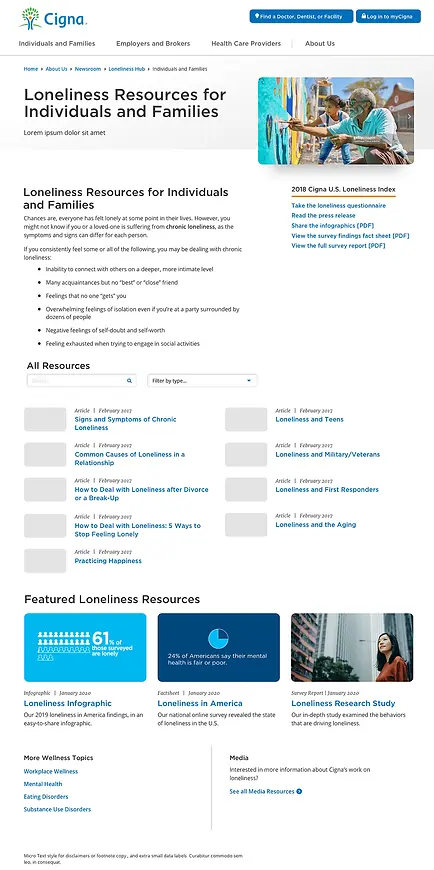
Loneliness Resources for Individuals and Families with dynamic articles list

Loneliness Resources for Health Care Providers

Separate page for Loneliness Report LeadGen

Loneliness Resources for Employers

Loneliness Report LeadGen form submitted
Looking Back
I learned quite a few lessons from the Loneliness Hub project.
Provide clear and consistent communication with stakeholders.
-
Because of shifting requirements, it was important to constantly communicate with the stakeholders to ensure they were aware of the current status of the project.
-
In order to clear any potential confusion, I learned to make sure every nuance of feedback from the stakeholders was addressed.
Place accessibility at the forefront when working with vendors.
-
Early on, we talked with the vendor to ensure the assets they provide, including the infographic, factsheet, and report, all met accessibility standards set by the company. When several elements of the assets still did not meet accessibility standards, we pushed for those concerns to be addressed, as all assets and resources should match Cigna.com accessibility standards.
Consider how the project may evolve in the future.
-
Although the final iterations were not considered at the time, I'm glad I worked through creating the improved experience of the overall hub.
-
If future content is to be added to this project, I know that the most recent iteration, with resources for each audience displayed on separate pages, will be an effective approach.
"Even though [the Loneliness Hub] is just a couple of pages, it is so high profile and had such a squished timeline, but Athira was able to turn her work around faster than expected. Her attention to detail has been crucial, as she found several issues during BAT that no one else noticed. She has and continues to be integral."
- extremely kind words from the Project Manager
Outcomes
Cigna CEO David Cordani discussed the findings of the Cigna 2020 Loneliness Index at a Business Insider event.

The Loneliness Index findings were reported on widely, with the Loneliness Hub tied in as the go-to page to learn more.

The Loneliness Hub has been on the Cigna.com homepage for over a year, which receives about 15 million visitors each month.
The Loneliness Hub is the go-to place to learn more about all of Cigna's work on the Loneliness Index.
Additional details on the Loneliness Index findings can be found on the Business Insider article.